
TL;DR
- You do not need a huge following to sell digital products; you need the right people who care about the problem your product solves.
- Bakers can reach potential buyers through social media, collaborations, search, paid promotion, existing contacts and direct outreach to relevant businesses.
- Getting discovered is only the first step. Give interested people a reason to follow you or join your email list so you can stay connected.
- You do not need to be everywhere. Choose one or two realistic ways to get found and build from there.
IN THIS ARTICLE
- How Do You Market Digital Products as a Baker?
- How to Promote Digital Products on Social Media
- How to Build an Audience Through Collaborations
- How to Market Digital Products Through Google, Pinterest and AI Search
- Can Paid Ads Help You Market Digital Products?
- How to Market Digital Products to Other Bakery Businesses
- You Do Not Need a Huge Audience to Sell Digital Products
- Do You Need to Market Your Digital Products Everywhere?
- How to Start Marketing Your First Digital Product
- What Is the Best Way to Build an Audience for Digital Products?
Creating a recipe ebook, baking guide, template or app is only one part of selling a digital product. You also need people who are interested in what you have created.
That does not mean you need tens of thousands of followers before you can start. In fact, a smaller group of people who are genuinely interested in the problem your digital product solves can be far more valuable than a large audience that simply enjoys looking at your cakes.
When bakers ask how to market digital products, the conversation often jumps straight to Instagram, TikTok or paid ads. But those are only individual channels. The bigger question is how you are going to get your digital product in front of the right people and give those people a reason to stay connected with you.
There are several ways to do that. You can start with an audience you already have, grow through social media, get in front of somebody else’s established audience, create content that can be found through search, pay to reach people who fit your target audience, or contact relevant businesses directly when your product helps them with their work.
You do not need to use every method. The goal is to choose one or two realistic ways for the right people to discover you, then create a way for those people to keep hearing from you.
How Do You Market Digital Products as a Baker?
Marketing a digital product starts with understanding who the product is for and where those people already spend their time.
For a baker, that might mean creating useful Instagram content, writing blog posts that answer questions people are searching for, appearing inside another baking community, building an email list or promoting a product to people who already follow your work.
The exact channel matters less than the principle behind it.
You need to get in front of people who have a reason to care about the problem your product solves, give them useful information that shows you understand that problem, and then give interested people a way to stay connected with you. That is the foundation of audience building.
Start With the Audience You Already Have
Before trying to build an audience from scratch, look at the people who already know your work.
You may already have Instagram followers, bakery customers, email subscribers, members of a Facebook group, people who regularly reply to your stories or customers who repeatedly ask you questions about how you bake, decorate or run your business.
Those people can provide useful clues about what your potential digital product audience is interested in.
There is an important distinction here, though. Your existing audience is only useful if there is some overlap between what they currently follow you for and what you want to sell.
For example, imagine you run a celebration cake business and most of your Instagram followers are local customers looking for birthday cakes. You then decide to create a guide teaching other cake makers how to achieve sharp buttercream edges.
Some of your followers may be bakers, but many may simply want to buy cakes.
Your current following therefore should not automatically be treated as your digital product audience.
On the other hand, if your comments and messages are regularly filled with other bakers asking how you achieve those edges, what tools you use and how you stop your buttercream from bulging, you already have evidence that part of your audience is interested in learning from you.
Look at the questions people ask, the posts they save, the topics they reply to and the things they repeatedly want your help with.
Audience building often starts by paying closer attention to the people already listening.
How to Promote Digital Products on Social Media
Social media is one of the most obvious ways to build an audience because platforms such as Instagram, TikTok, Facebook and YouTube can show your content to people who do not already follow you.
The basic idea is simple. You create content around the interests, problems and questions of the people your digital product is designed to help. The platform then has opportunities to show that content to people who may be interested in it.
If they find the content useful, interesting or relevant, some of them may choose to follow you.
Over time, you begin building a group of people who associate you with a particular subject.
A sourdough baker might become known for explaining fermentation problems. A cookie decorator might become known for royal icing techniques. A home bakery owner might talk about pricing, production or selling at markets.
The important thing is that your content should connect to the knowledge you eventually want people to buy.
If you want to sell a sourdough troubleshooting guide but all of your social content consists of attractive photographs of finished loaves, you may build an audience that enjoys looking at bread without necessarily building an audience that wants to learn sourdough from you.
The content needs to give the right people a reason to think, this person understands the thing I am trying to learn.
Social media can be powerful, but it is not usually instant. You are working with an algorithm, competing for attention and learning which topics your audience responds to. Building a useful following normally requires consistency and experimentation.
That is why I would not rely on follower numbers alone as evidence that you are ready to sell a digital product.
Pay attention to whether people are asking questions, saving your content, replying, joining your email list and showing signs that they want deeper help. Those signals can tell you much more than a follower count.
How to Build an Audience Through Collaborations
You do not always have to build an audience one person at a time. Another option is to get in front of an audience somebody else has already built.
This could happen through a guest workshop, podcast interview, virtual summit, Facebook community, membership, newsletter, industry organisation or collaboration with another educator or business.
The advantage is obvious. Instead of waiting months for an algorithm to gradually introduce you to new people, you can be introduced directly to a group that already contains people you want to reach.
But this works best when you approach it as an exchange of value rather than simply asking somebody to promote you.
For example, imagine you specialise in turning baking knowledge into digital products and you collaborate with an educator whose community is made up of experienced cake makers.
You could teach a useful session about turning a popular recipe or technique into a first digital product.
The audience receives something genuinely useful. The host gives their community additional expertise. And the people who want to hear more from you can choose to follow you or join your email list afterwards. That last part matters.
Borrowing somebody else’s audience only helps you build your own audience if interested people have somewhere to go next. You might invite them to download a relevant free guide, join your email list, follow you on social media or visit a useful article on your website.
The aim is not to take somebody else’s audience. It is to be useful enough that some of the people in that audience decide they would like to continue hearing from you.
A good example of this is Yessica Vera, who first became visible by sharing useful cookie-pie advice inside existing baking communities before building her own focused audience. Her approach shows how being genuinely helpful in someone else’s community can lead interested people back to you.
How to Market Digital Products Through Google, Pinterest and AI Search
Search works differently from social media. On social media, you are usually creating content and hoping the platform places it in front of someone who will find it interesting.
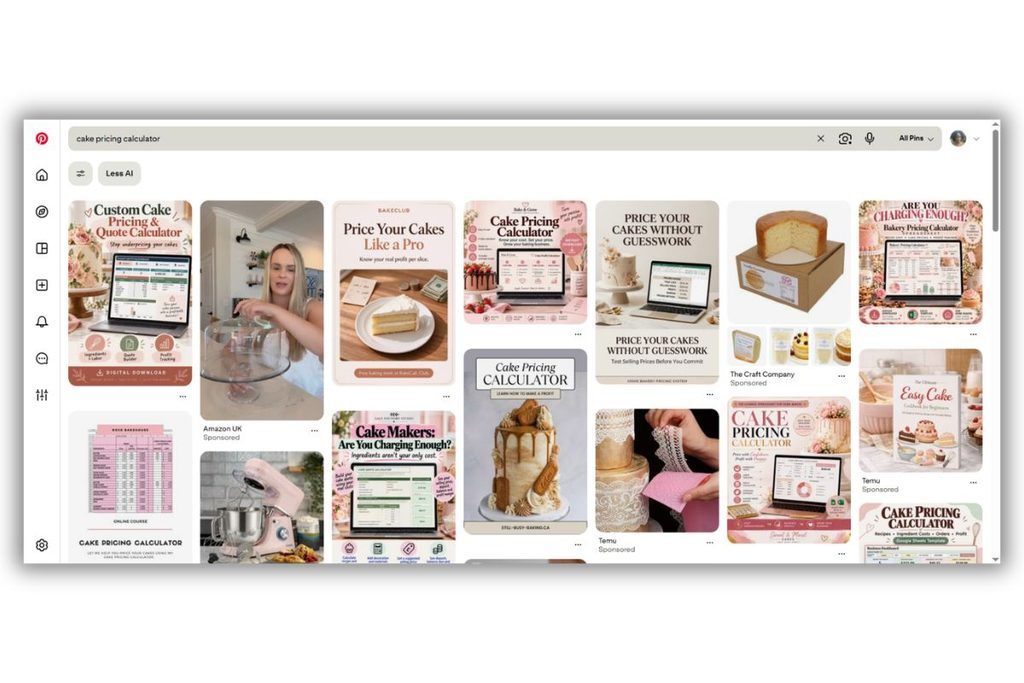
With search, the person is already looking for something. They may type a question into Google, search for an idea on Pinterest or ask an AI search tool for help with a problem.
That makes search particularly useful for digital products because someone who is actively looking for an answer is already showing interest in the subject.
Imagine you eventually want to sell a guide about pricing custom cakes. Potential customers might already be searching for questions such as:
- “How much should I charge for a custom cake?”
- “How do I calculate cake prices?”
- “Why am I not making money from my home bakery?”
If you create genuinely useful content around those questions, people can discover your expertise before they ever know your product exists.
The same principle applies whether you are using a blog, Pinterest or content that may later be surfaced through AI search. Start with the questions and problems your audience is already asking. Then create content that answers those questions clearly and thoroughly.
This is also why specific content is often more useful than very broad content. An article called Everything You Need to Know About Baking gives a search engine very little idea about exactly which problem it solves.
An article called Why Does My Cheesecake Crack? 7 Common Causes and How to Fix Them has a much clearer purpose.
The same thinking can be applied to the content surrounding your digital products. If you sell a cookie pricing spreadsheet, you might write an article about calculating ingredient costs, packaging costs or profit margins.
If you sell a macaron guide, you might create content about hollow shells, cracked macarons or drying times.
If you sell a recipe ebook, you might answer common questions related to the recipes or techniques inside it. Each useful piece of content gives another person a way to discover you.
Search also has one important advantage over content that depends entirely on a social feed: useful search content can continue bringing people to you long after it has been published.
You still need patience. SEO and search visibility are rarely immediate. But over time, a collection of helpful content around the problems your audience cares about can become a reliable way for new people to find you.
Once people start discovering your content, you also need somewhere to send them when they are ready to buy. I’ve broken down the main options in my guide to where to sell digital products online, including marketplaces, hosted platforms and your own website.
Can Paid Ads Help You Market Digital Products?
You can also pay to put your content or offer in front of more people. That might include advertising through Meta, Pinterest, Google or another platform.
Paid promotion can speed up reach because you are not relying entirely on organic search or an algorithm to gradually distribute your content.
But I would not treat advertising as a shortcut around understanding your audience.
If you do not know who the product is for, what problem matters to them or what message makes them pay attention, paying to show that message to more people is unlikely to fix the problem.
Paid promotion becomes much more useful when you already have some evidence about what people respond to. For example, you may discover that a free guide about fixing common macaron problems consistently attracts email subscribers. You could then test paid promotion to get that guide in front of more people who are interested in macarons.
The advertising is increasing the reach of something that has already shown signs of working. For someone selling their first digital product, paid promotion is therefore an option rather than a requirement.
How to Market Digital Products to Other Bakery Businesses
If your digital product helps another bakery run its business, you may need a different approach from someone selling recipes to home bakers. Your potential buyer could be a bakery owner, production manager or baking school director. These people may never see your baking content, even if the product would be useful to them.
For example, imagine you have created software that helps bakeries turn wholesale orders into daily production plans. Your local cake customers are unlikely to need it. A bakery supplying several cafés, however, may regularly deal with the problem your software solves.
Alongside creating helpful content and building industry relationships, you can introduce your product directly to suitable businesses by email. This means identifying businesses that could benefit, finding the person responsible for the task and writing a relevant, personal message.
Start With the Businesses Most Likely to Need Your Product
Be specific about who you want to help. “Bakeries” is a broad group. A home baker taking a few celebration cake orders each month may have very different needs from a bakery managing daily production for several shops.
Think about the situation that makes your product useful. Does it help teams organise staff, calculate production quantities or manage regular wholesale orders? Then look for businesses whose work involves that task.
You can research potential buyers through bakery websites, industry directories, associations, professional networks and platforms like LinkedIn’s Sales Navigator. Start with a small, carefully chosen group so you can understand their businesses and make each approach relevant.
Use Email to Start a Useful Conversation
Your first email should make it easy for the recipient to understand why you are contacting them. Briefly introduce yourself, explain the problem your product addresses and show why you think it could be relevant to their bakery.
For a production-planning tool, you might explain that you developed it after spending too much time transferring orders between messages and spreadsheets in your own bakery. You could then ask whether organising wholesale orders creates similar difficulties for their team.
Keep the next step manageable. Depending on how developed your product is, you might invite them to a short conversation, offer a demonstration or ask whether they would be interested in testing it.
A demonstration means showing someone how the product works using a task they recognise. Rather than listing every feature, you could show how an order becomes a production plan and explain what information the bakery needs to enter.
Be honest about what the product can currently do. If it is an early version, explain that. If you have not measured time savings or other results, avoid making promises you cannot support.
Follow Up and Learn From the Replies
Bakery owners are busy, so an unanswered email does not automatically mean they are uninterested. A brief follow-up can bring the message back to their attention. Add something useful, such as a short explanation of how the tool handles a relevant task, rather than repeatedly asking whether they saw your email.
Make your identity clear, respect requests not to be contacted and check the email marketing rules that apply to the businesses you approach. A publicly listed email address does not automatically mean someone has agreed to receive a marketing newsletter.
The replies can help you improve the offer as well as find customers. If several owners ask about moving their recipes into the system, you may need to explain the setup process more clearly. If they already use another tool, ask what works well and where they still struggle.
For software, the conversation may continue beyond the first expression of interest. An owner might need to see a demonstration, involve a colleague or understand the setup and ongoing costs before deciding.
You do not necessarily need a large following to begin these conversations. You need a clear understanding of which businesses could benefit, a useful product and a relevant reason to contact them.
Give People a Reason to Stay Connected With You
Getting discovered is only the first part of building an audience.
Someone could find one of your Pins, watch one of your Instagram Reels, read a blog post or attend a workshop you delivered inside somebody else’s community. Then they leave. Unless you give them a reason to stay connected, you may never reach that person again.
One option is asking them to follow you on social media. But you can also give people a reason to join your email list.
This might be a useful free guide, checklist, recipe, mini training, template or another small resource directly related to the subject you teach.
For example, if you eventually want to sell a detailed guide about cookie pies, a free introductory cookie-pie guide could attract people who are already interested in that exact subject.
If you want to sell resources for cake business owners, a pricing calculator or checklist might help identify people who want help running a more profitable bakery.
The important part is relevance. A huge email list built through an unrelated giveaway is not automatically useful. A smaller list of people who asked for help with the same problem your paid product solves can be much more valuable.
Curious About Digital Products?
Get The Home Baker’s Guide To Starting A Digital Bakery
If you enjoy baking and sharing your recipes, whether at local events, on social media or with friends and family, this free guide will help you explore how your recipes, baking skills and knowledge could become digital products you can sell online.
You Do Not Need a Huge Audience to Sell Digital Products
One of the biggest mistakes bakers can make is assuming they need to reach a particular follower milestone before they are allowed to create a digital product. There is no magic number.
What matters is whether enough of the right people care about what you are offering.
A baker with 25,000 followers who mostly enjoy photographs of wedding cakes may struggle to sell a technical ebook about running a profitable cake business.
Another baker with 1,500 followers made up largely of cake makers who regularly ask about pricing might have a much stronger starting point.
That is why I would focus less on How many followers do I have? and more on Who are these people, and what are they showing me that they need? Audience quality matters.
You can see this in practice in my guide to launching a recipe ebook with a small audience, which looks at why a smaller group of people who are highly interested in one subject can be more useful than a much larger general following.
Do You Need to Market Your Digital Products Everywhere?
No. Trying to build an audience on every platform can quickly become another full-time job. You do not need Instagram, TikTok, Facebook, YouTube, Pinterest, a podcast, a blog and a newsletter all at once. Choose one or two realistic ways for new people to discover you and one reliable way for interested people to stay connected.
For one baker, that might be Instagram and email. Another might focus on Google and Pinterest bringing people to a website, with an email list capturing the people who want more.
Someone else might grow primarily through teaching inside established communities and partnerships, then invite interested people onto an email list.
There is no requirement to use every channel. The better question is whether the channels you have chosen actually put you in front of the type of person your product is designed for.
How to Start Marketing Your First Digital Product
If you are starting from the beginning, do not make audience building more complicated than it needs to be.
Start by identifying who the product is for and what problem it helps them solve. It also helps to start with something people have already shown interest in. Kylie’s story is a good example: one cake recipe that had already built demand in her bakery later became a digital product she could sell online.
Then look at whether some of those people already exist inside your current audience.
If they do, begin listening more closely to what they ask and respond to.
If they do not, choose one main way to start getting in front of them. That might be useful social content, search-focused articles, collaborations or direct email outreach if your buyers are other businesses.
Then create a simple way for interested people to stay connected with you, ideally through an email list as well as social media. You can add more channels later. What matters in the beginning is creating a simple system: the right people discover you → they find your content useful → they stay connected → you learn what they need → you create and sell digital products that help them.
That is audience building in its simplest form.
What Is the Best Way to Build an Audience for Digital Products?
There is no single channel that works for every baker.
Social media can introduce you to new people through algorithms. Search can help people discover you when they are actively looking for answers. Collaborations can put you in front of established communities. Paid promotion can increase your reach. Your existing customers and followers may already contain people who want what you plan to teach. If your product helps other businesses, a relevant personal email can also introduce you to potential buyers.
The strongest approach is usually not trying to do everything. It is understanding who you want to reach, choosing a realistic way to get in front of them and consistently giving those people useful reasons to keep listening.
Your audience can then grow alongside your digital product business rather than becoming something you believe you have to finish building before you begin.
Ready to start building your digital bakery?
Download the free Digital Bakery Guide and start identifying the recipes, skills and knowledge you could turn into a digital product. Get the Guide.
FREQUENTLY ASKED QUESTIONS
Questions bakers often ask about digital products
How do I market a digital product if I have no audience?
Start by deciding exactly who the digital product is for. Then choose one main way to get in front of those people, such as social media content, search-focused articles, Pinterest, collaborations or paid promotion. Give interested people a reason to follow you or join your email list so you can continue the relationship.
How do I promote digital products without social media?
You can use search focused blog content, Pinterest, email marketing, collaborations, guest teaching, podcasts, communities, partnerships or paid search. Social media is only one way of reaching potential customers.
Can AI search help people discover my digital products?
AI search tools can surface and recommend useful information from across the web when answering questions. Creating clear, specific and genuinely helpful content around the problems your audience is asking about can give search systems more useful information to understand what your content covers. You should still focus first on producing content that genuinely answers the reader’s question rather than writing only for an algorithm.
Should I build an email list before selling a digital product?
You do not have to wait until you have a large email list before selling, but an email list gives interested people a direct way to stay connected with you. A small list built around the same subject as your paid product can be particularly useful when you are preparing to launch.